DiskMac icon DiskMac

See where your Mac’s storage actually went.

A treemap of every folder, the largest files on the disk, an uninstaller that removes what apps leave behind — and a second mode that understands Xcode, Docker, Node and Gradle. Native, 1.6 MB, and it never sends anything anywhere.

109 GB scanned in 34.8s 1.6 MB app No telemetry Undo any cleanup
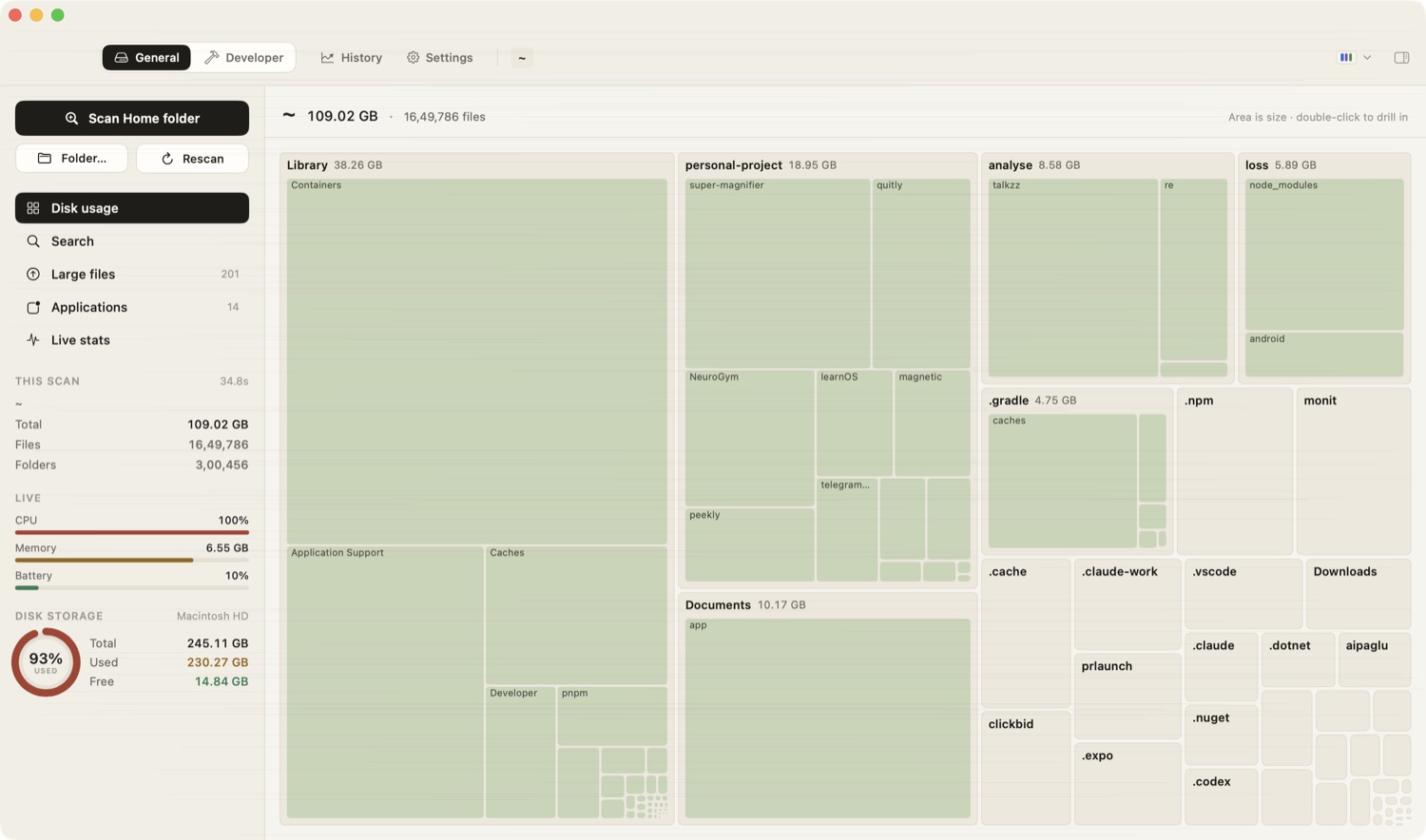
DiskMac showing a treemap of a home folder: Library 38.26 GB, personal-project 18.95 GB, Documents 10.17 GB

One app, two jobs

General for your Mac. Developer for your toolchain.

Most disk tools stop at “this folder is big”. DiskMac does that properly, then adds a second mode that knows what Xcode, Docker, Node, Gradle and six other toolchains leave behind — and why each piece is safe to remove.

General mode

Any folder on the Mac

  • Treemap of where the space went, nested two levels
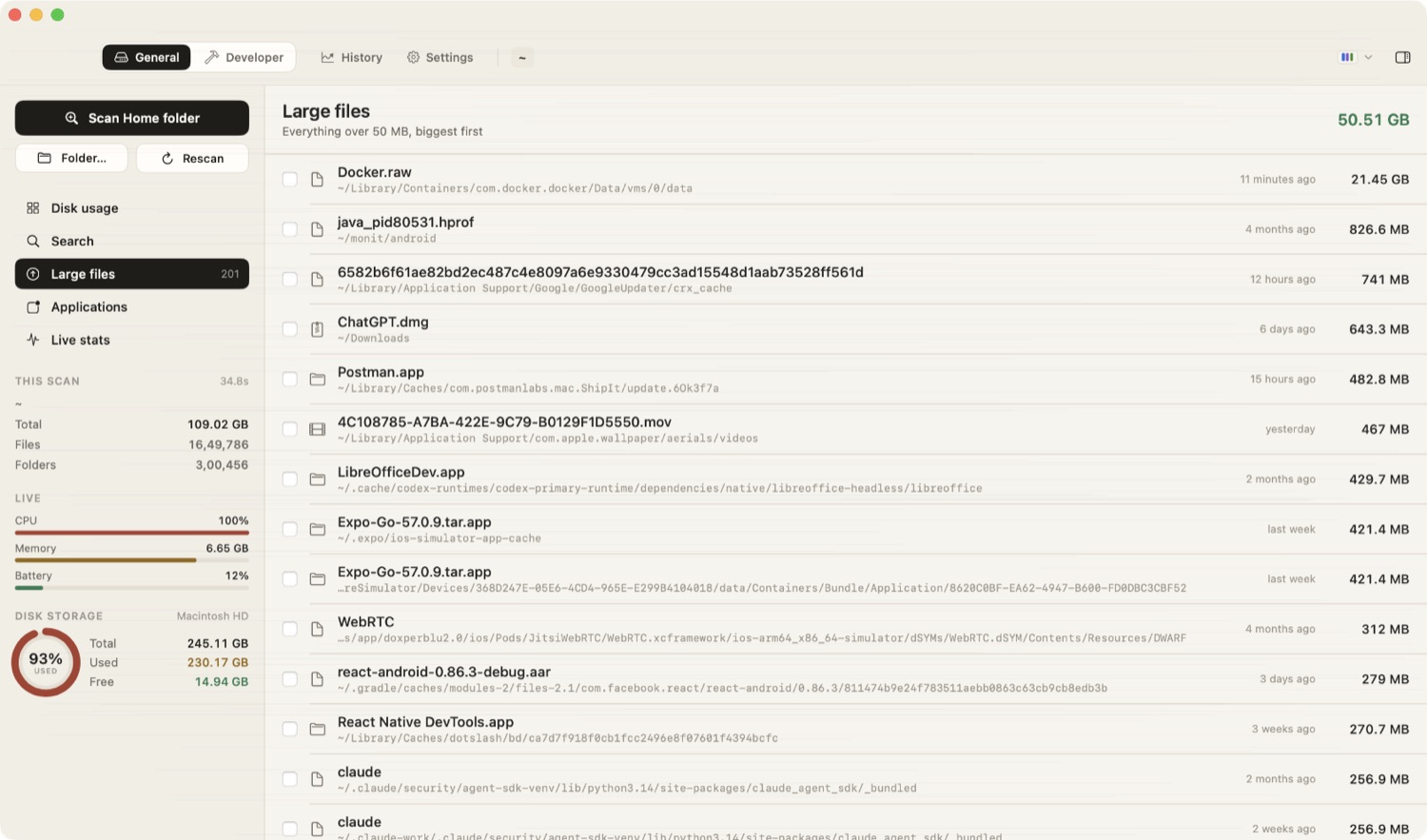
  • Every file over 50 MB, biggest first
  • Instant search across the whole scan
  • Live CPU, memory and battery
  • Uninstall apps and their leftovers
Developer mode

What your tools left behind

  • Xcode, Docker, Node, Android, Gradle, CocoaPods, React Native, Flutter and more
  • Every item explains why it is safe and how it comes back
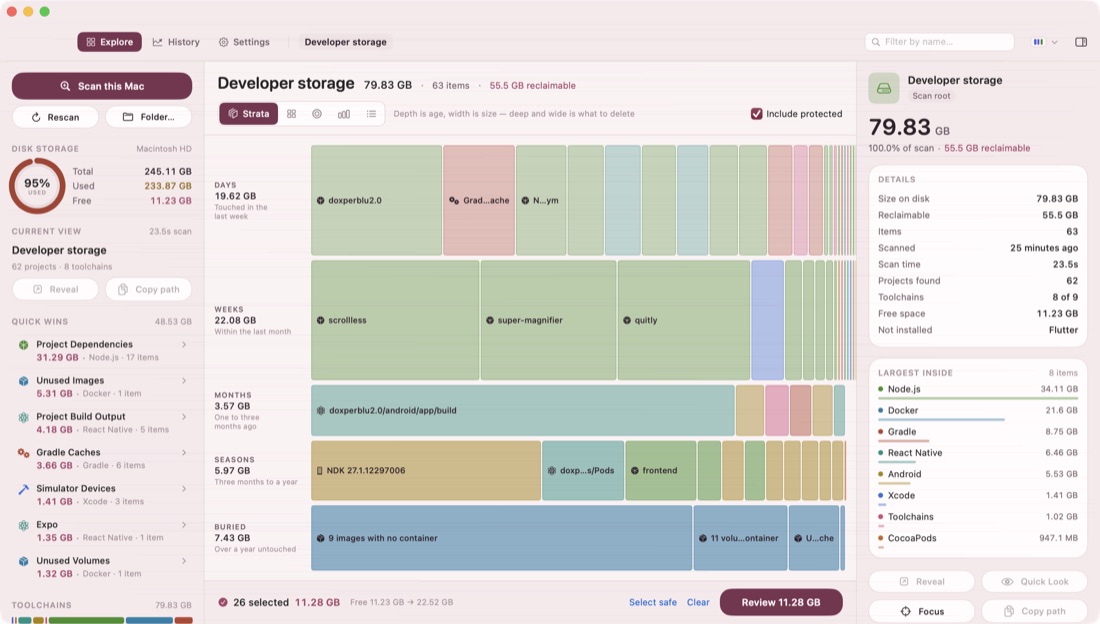
  • Strata: size and age, so old and huge stands out
  • Never touches source code, keys or credentials
  • A free command line tool that shares the same engine
DiskMac's large files list: Docker.raw at 21.45 GB, a java heap dump at 826 MB, a downloaded disk image at 643 MB

Find large files

The ten things eating your disk, in one list.

Collected during the scan, so it appears the moment the scan ends. Real paths, real dates, and a size that reflects what is actually allocated on disk rather than what a file claims.

On the Mac this was built on, the top entry was Docker.raw at 21.45 GB — a file that reports itself as 245 GB and is invisible in Finder.
Hard links are counted once, so a package store is never billed three times over.
Select anything and remove it, with everything going to the Trash so it can come back.

App uninstaller

Dragging an app to the Trash leaves most of it behind.

The bundle goes. The caches, containers, preferences, saved state, web storage, logs and launch agents stay — for years. DiskMac finds them by bundle identifier, which is exact, shows you every path it matched and why, and removes the lot together.

Application Support

The big one. Often gigabytes per app.

Containers

Sandboxed data, keyed by bundle identifier.

Caches

Rebuilt on demand, kept forever otherwise.

Preferences

The plist that remembers an app you deleted.

Saved state

Window positions from a version you no longer run.

Launch agents

Background jobs that outlive the app itself.

Every match shows the identifier it was matched on, so you can check the reasoning rather than trust it. Apple’s own bundled apps are listed but never offered for removal.

Developer mode

Size tells you what is big. Age tells you what to delete.

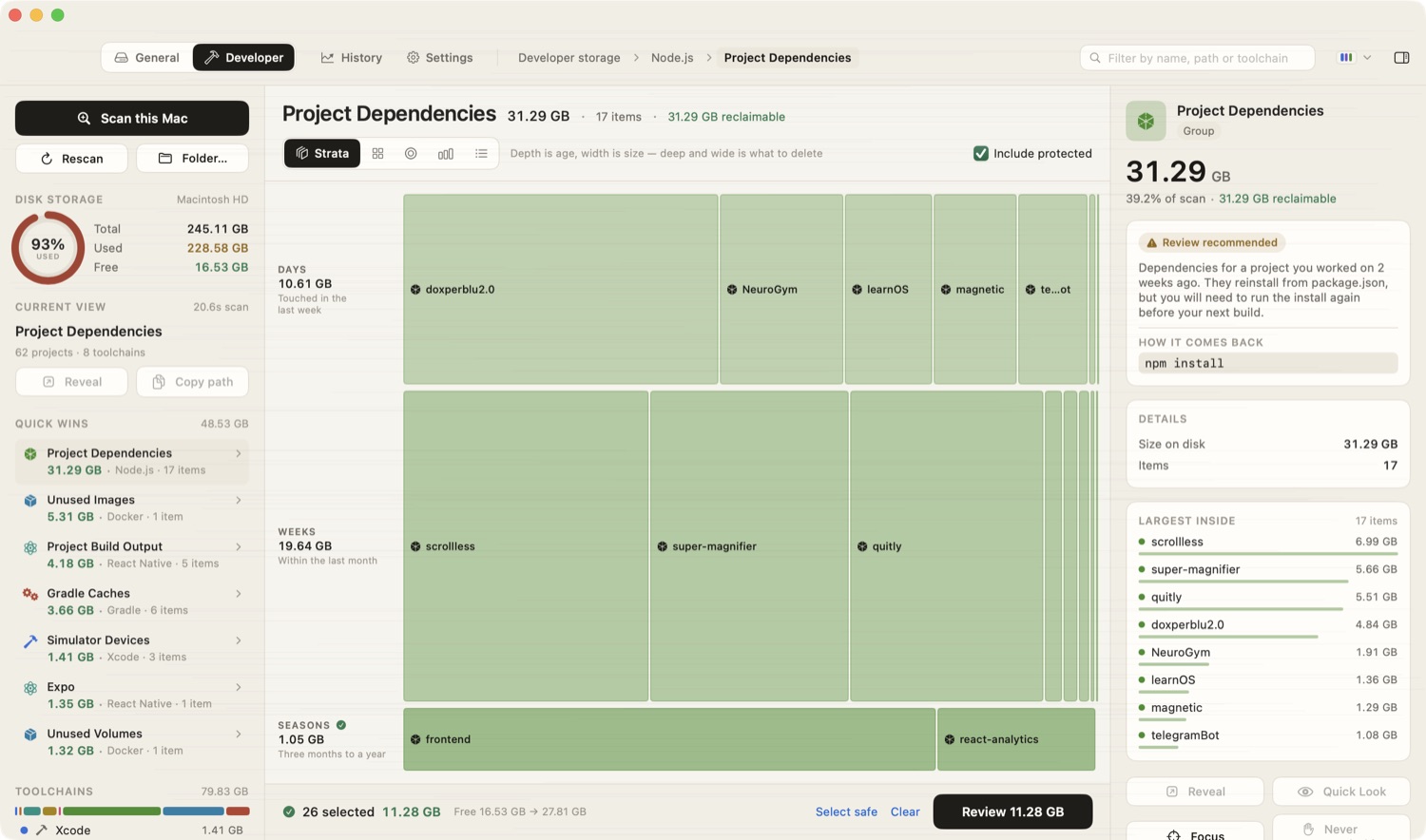
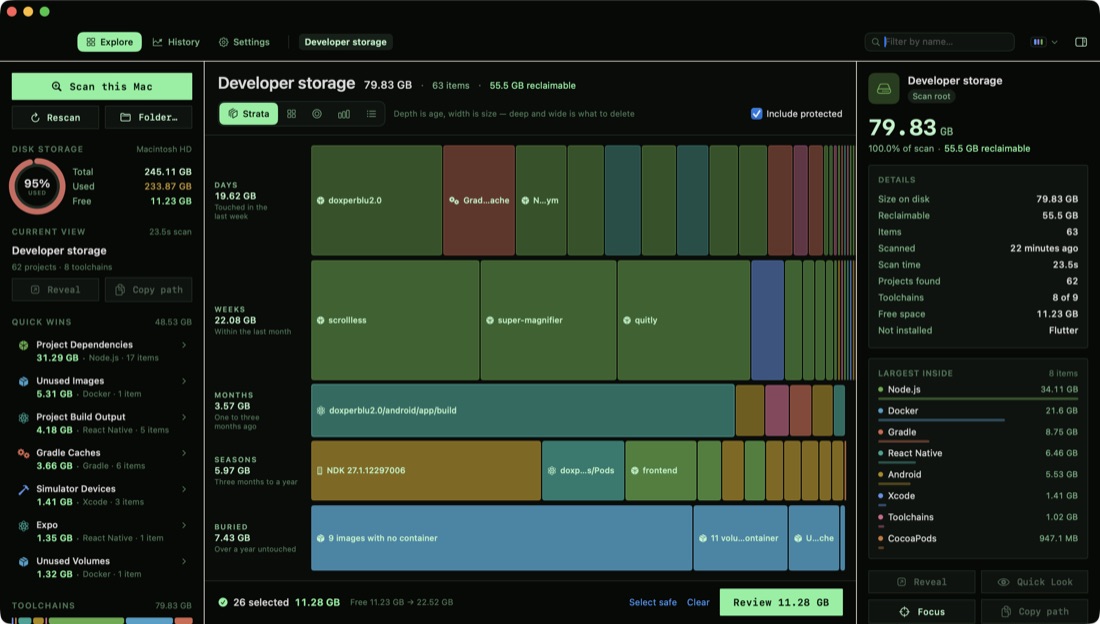
A 6 GB folder you built this morning is not the same decision as a 6 GB folder from last spring. Strata puts age down the side and size across, so what you want gone is whatever is both deep and wide. Click a band to select all of it.

Strata view grouping developer storage into age bands

Strata — bands from Days down to Buried, with band height proportional to bytes.

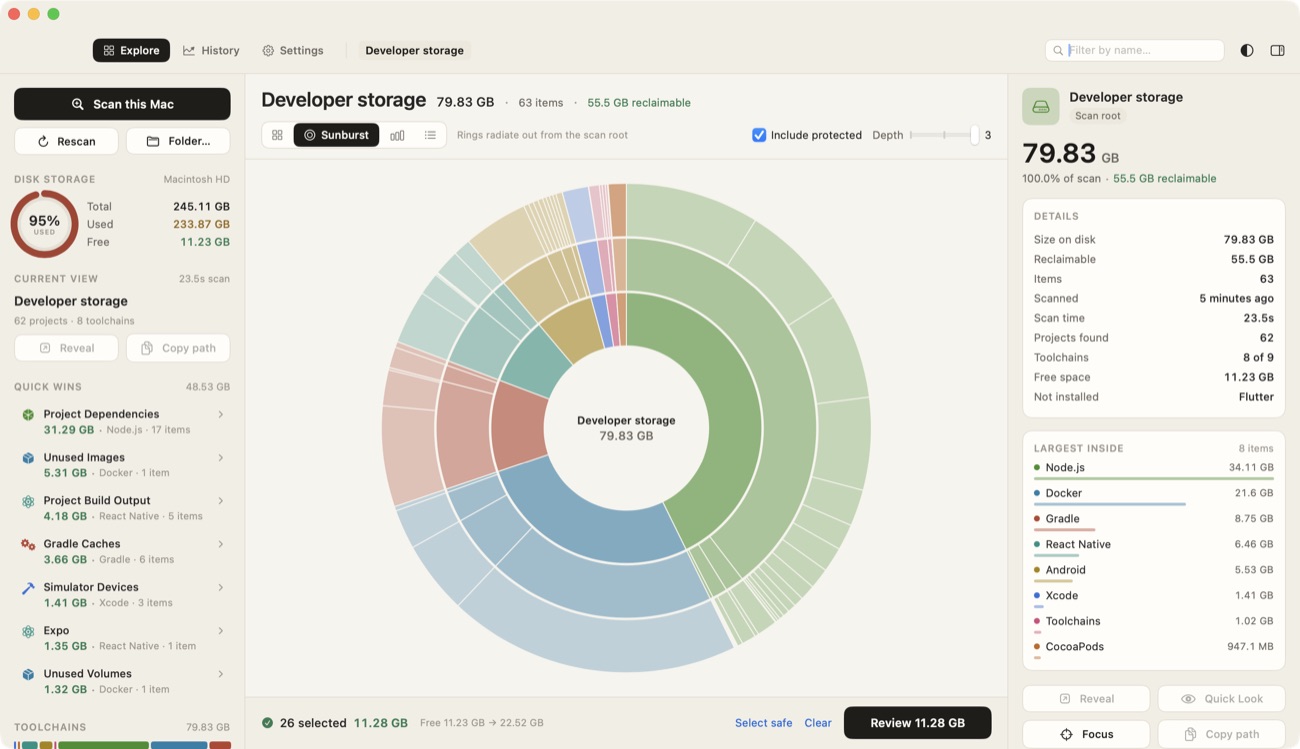
Sunburst view of developer storage

Sunburst — rings radiating from the scan root, to whatever depth you choose.

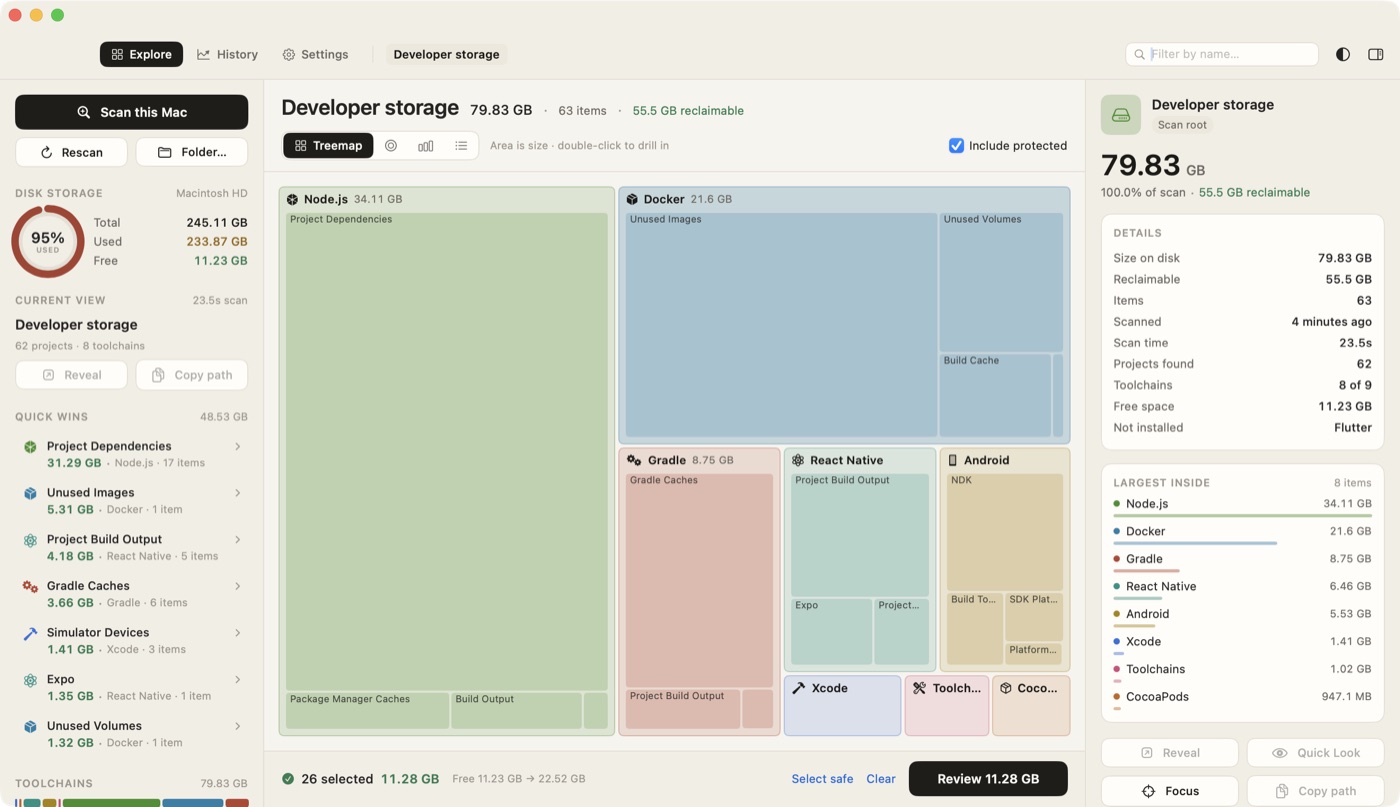
Treemap of developer storage by toolchain

Treemap — area is size, nested by toolchain. Double-click to drill in.

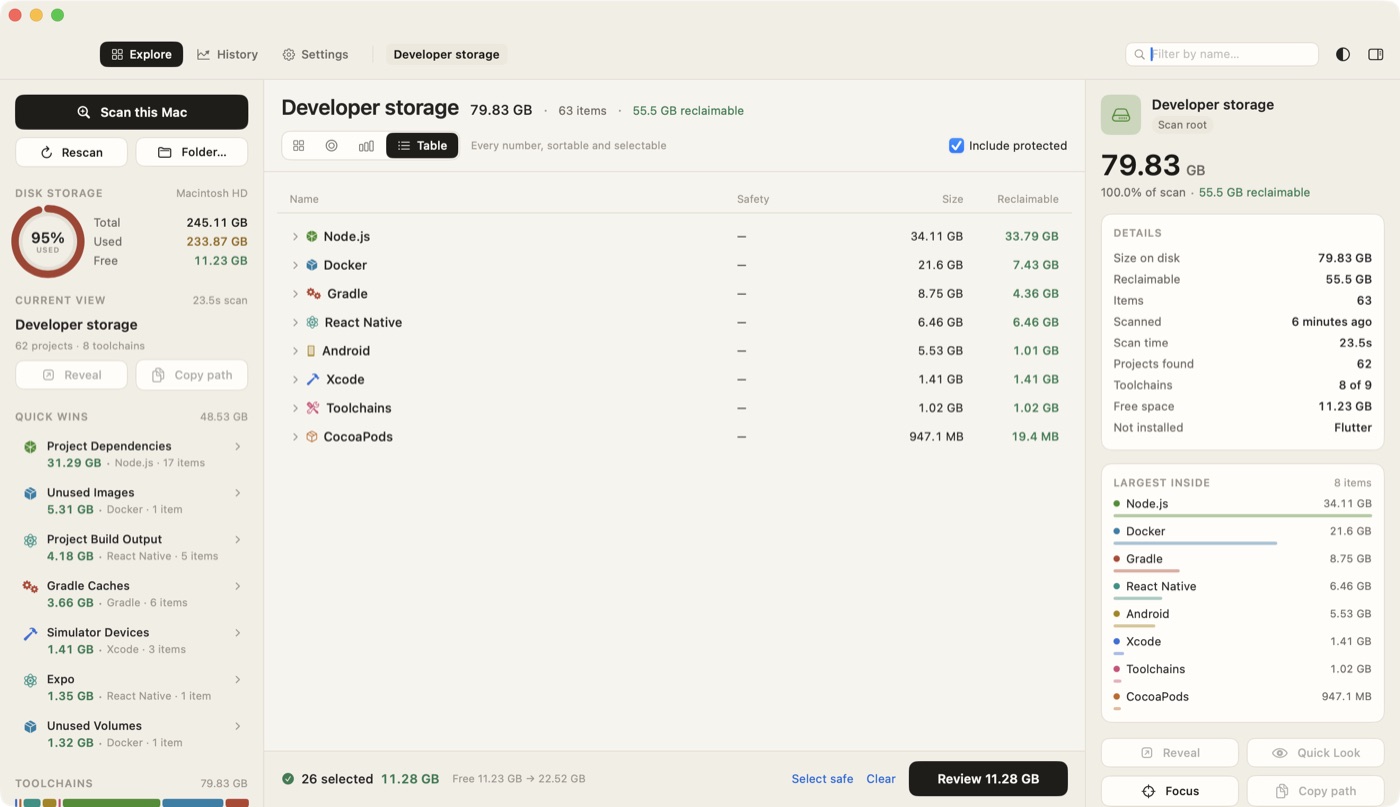
Table view listing every toolchain with sizes

Table — every number, expandable, and where identity never depends on colour.

Safety

It cannot reach your work.

Every removable path must match a shape its own rule registered in advance and clear a deny list. Both checks run again in the instant before removal, so a folder that changed underneath you is skipped rather than deleted.

Never source code — a folder holding a .git is treated as work, not output.
Never keys or credentials — SSH, keychains, .env and cloud configs are permanently denied.
Never a swapped link — if a folder became a symlink after the scan, it is skipped.
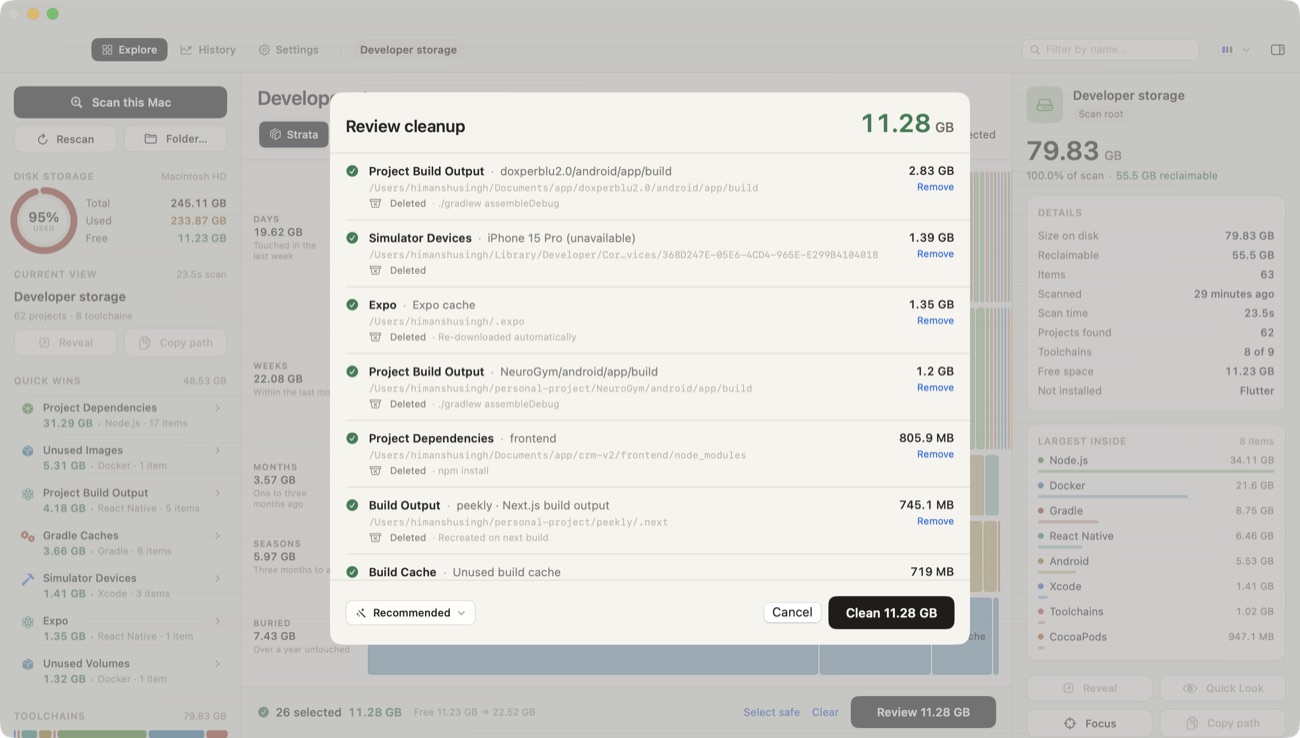
Undo everything — items go to the Trash and one button puts them back.
No network code at all — nothing to send, nowhere to send it.
The review sheet listing each item with its full path and the command that restores it

Themes

Nine of them, and you will look at this.

Not a colour swap. Each is a whole identity — surfaces, typography, corner radius, texture. Paper and Graphite are free; the other seven come with Pro.

DiskMac in the Terminal theme: phosphor green on near-black, monospaced DiskMac in the Bloom theme: soft rose with generous curves

How buying works

Four steps, and no account to create.

Pay on this site

Checkout is handled by Dodo Payments. Card, UPI and wallets. Tax is calculated and handled for you.

Get your key by email

A licence key arrives immediately, and is shown on the confirmation page.

Paste it into DiskMac

Settings › Licence, or the Pro window. One paste, one click.

Pro unlocks

Activated for two Macs. Works offline afterwards; nothing to renew.

Pricing

Free forever. Pro once.

Everything you need to see your disk is free, with no limits and no account. Pro is for acting on what you find.

Free $0
  • Visualise disk usage (Treemap)
  • Power search
  • Find large files
  • Live stats (CPU, memory, battery)
  • Developer mode scanning
Download
Lifetime licence Pro $9 once + tax
  • Everything in Free, plus:
  • Delete files within the app
  • App uninstaller with residue cleanup
  • Super Power search
  • Reveal & open file paths
  • One-click “Show in Finder”
  • Open archives & folders directly
  • Premium theme customisation
  • Priority support
Get DiskMac Pro Secured by Dodo Payments · 15-day refund

Questions

The ones worth asking.

Is this a subscription?
No. Pro is a single $9 payment plus tax, covering two Macs, with no expiry and nothing to renew. If a major new version ever appears it will be a separate, optional purchase — your licence will keep working.
Could it delete something I need?
Every removable path has to match a shape registered in advance by the rule that produced it, and clear a deny list covering source code, git repositories, credentials, keychains, Documents, Desktop and anything outside your home folder. Both checks run again immediately before removal. Anything costly to restore goes to the Trash and one button puts it back.
Does it send anything anywhere?
The scanning and cleanup code contains no network calls at all. The only time DiskMac touches the network is to check your licence key with Dodo Payments, and that request contains the key and a device name — never a file name, path or size.
How long does a scan take?
About 35 seconds for a 109 GB home folder with 1.6 million files, on Apple silicon. Smaller folders are near-instant. It reads directory metadata with POSIX calls rather than the slower high-level APIs, and walks several folders at once.
Why is it not on the Mac App Store?
Sandboxing forbids the file access a storage scanner needs, so a Store build would be blind to most of what DiskMac finds. It is distributed directly, signed and notarised by Apple.
What happens if I am offline?
Pro keeps working. DiskMac re-checks your licence when it can, and if that fails for any reason it carries on for a two-week grace period. A paying customer on a plane is never told they have not paid.
Can I move my licence to another Mac?
Yes. A licence covers two Macs at once, and you can deactivate one from Settings › Licence to free the slot.
Is there a refund?
15 days, through Dodo Payments. If DiskMac does not find enough on your Mac to be worth it, that is a fair reason and you should ask.

Find out where it all went.

The scan is free, takes about half a minute, and asks you for nothing.

macOS 13 or later · Apple silicon · 1.6 MB
DiskMac — see where your Mac’s storage went. Pricing  ·  FAQ  ·  Privacy  ·  Terms  ·  Refunds  ·  Support  ·  v1.0